
The problem
For over five years, Reece's Customer Care team had been dealing with the same unresolved pain point. When customers lodged warranty service cases requiring spare parts, those parts were shipped exclusively from the Melbourne distribution centre - regardless of where the customer was located. For someone in Perth or New Zealand, that often meant waiting weeks for a repair that should have taken days.
The problem didn't stop there. Once a parcel left the DC, Customer Care agents had no visibility over it. When frustrated customers called for updates, agents couldn't provide them. The result was a compounding cycle of poor customer experience, eroded trust, and high agent frustration.
Business problem: service delays and inefficient distribution processes created unnecessary costs and customer dissatisfaction.
Customer problem: customers couldn't get clear timelines for their repairs, eroding trust and brand experience.
Research and discovery
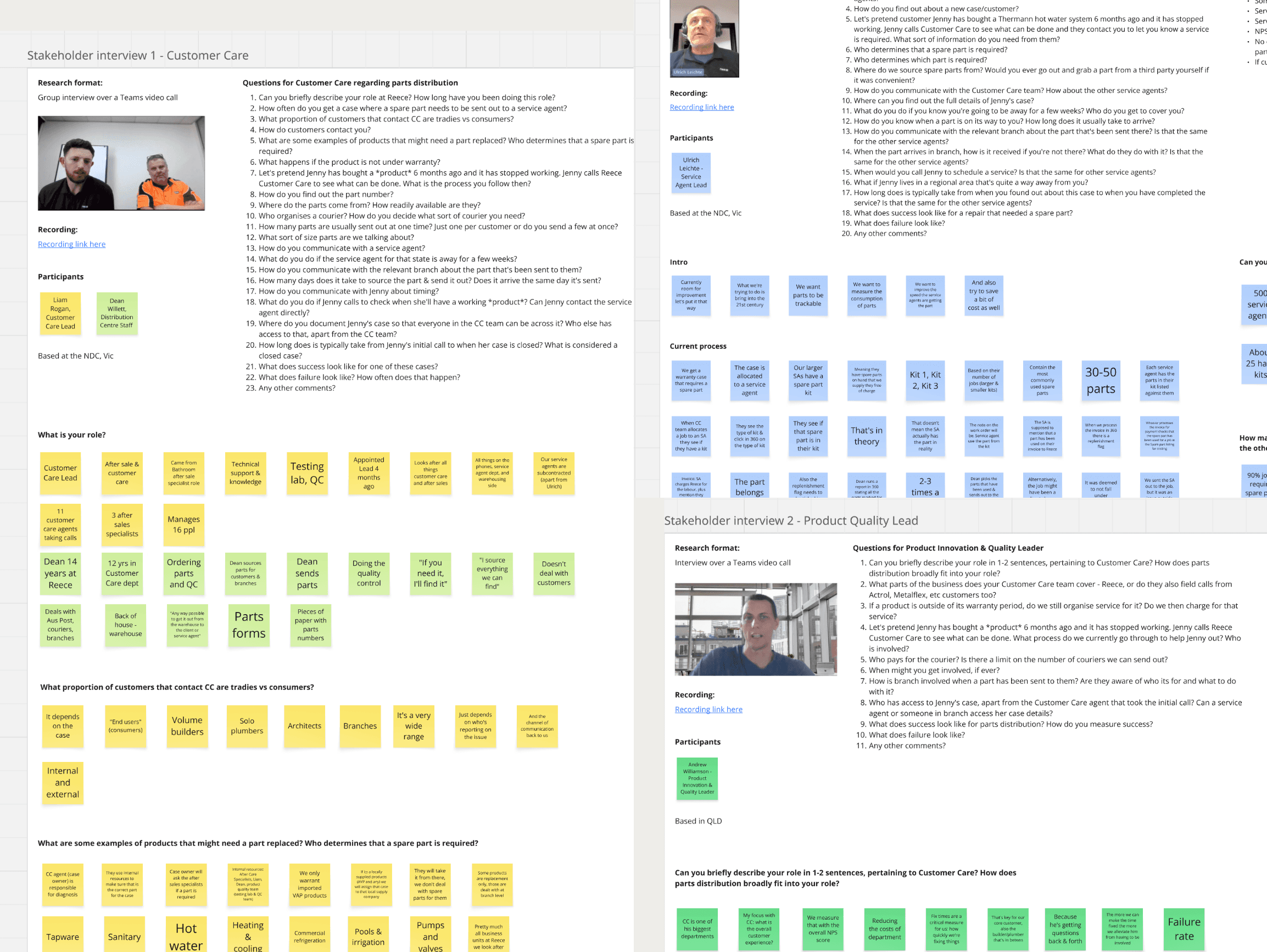
I started by interviewing members of the Customer Care team and the Product Innovation & Quality Leader to map exactly how the current process worked - and where it was breaking down.
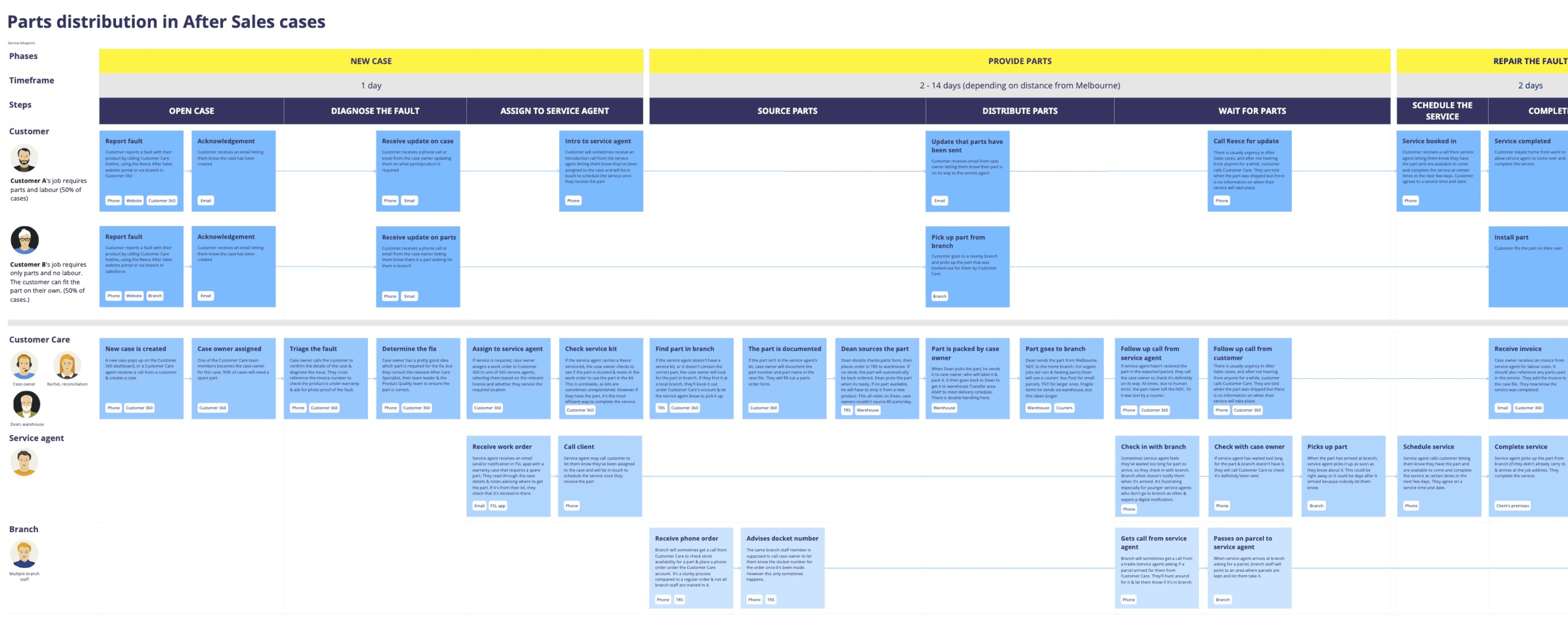
From those interviews, I created a service blueprint from scratch that made the problem visible in a way it hadn't been before. It showed:
How delays were cascading through to customers at each stage
The manual effort being absorbed by Customer Care agents, service agents, warehouse staff, and branch staff
Where the biggest inefficiencies and visibility gaps existed across the end-to-end journey
The blueprint became the shared artefact that grounded every subsequent conversation with stakeholders.
The hypothesis
With the current state fully mapped, I overlaid it against the ordering and tracking capabilities already available in maX - Reece's existing ecommerce platform used by trade customers.
The fit was strong, but getting there required some working through. Customer Care needed to be set up as users with the right account structure: one account per state. That way, agents could select the most relevant branch for each specific part, keeping fulfilment local and fast.
Now parts can be shipped from local distribution centres rather than the Melbourne DC, agents have full order visibility to keep customers informed, and no new development was required. The solution already existed. It just needed someone to oversee process alignment from an ecommerce perspective.

The pilot
To validate the hypothesis, I designed a 2-month pilot in which Customer Care agents used maX to order spare parts from two local branches - one in WA, one in QLD.
Designing the pilot meant more than defining the concept. I created the process flows and visual communications that made it clear to every party involved - Customer Care, branch staff, the maX Customer Success team - what would happen, when, and who was responsible for what. I also arranged for the maX Customer Success team to provide support throughout the trial.
Order part in maX
Track it in maX
Arrives same day
Stakeholder alignment was a significant part of this work. I reassured Merchandising that the new process required no additional effort on their part. I engaged Operations and the Digital Products team to support the trial. Working directly with branch leaders, I secured the buy-in needed on the ground.
The toughest stakeholder was Finance. The new model made it harder to distinguish cost centres from profit centres in the existing reporting structure. I provided the service blueprint and impact evidence to the Product Innovation & Quality Leader, who took it directly to the CFO - making the business case that the operational savings and customer experience gains far outweighed the accounting complexity. Finance came on board, and the Merchandising manager became a project champion, helping clear the remaining operational hurdles with Logistics to prepare for scale.
"The pilot went VERY well. Branches are really pro this solution… We are looking at expanding the pilot next month."
- Head of Product Quality
Results
The 2-month pilot delivered measurable impact across three areas:
Time to resolution
Average case duration dropped from 7.9 to 1.6 business days, achieved simply by shipping from the nearest branch rather than the Melbourne DC.
Agent confidence
Customer Care agents could now track orders and proactively update customers, with confidence ratings rising from 1.5 to 4.5 out of 5.
Coordination effort
The number of staff touches required to resolve a case fell from 5.5 to 2.5, reducing the operational load across the team.