Product discovery in the generative AI era: faster loops, same fundamentals
by Marina Watson
▪ September 2025
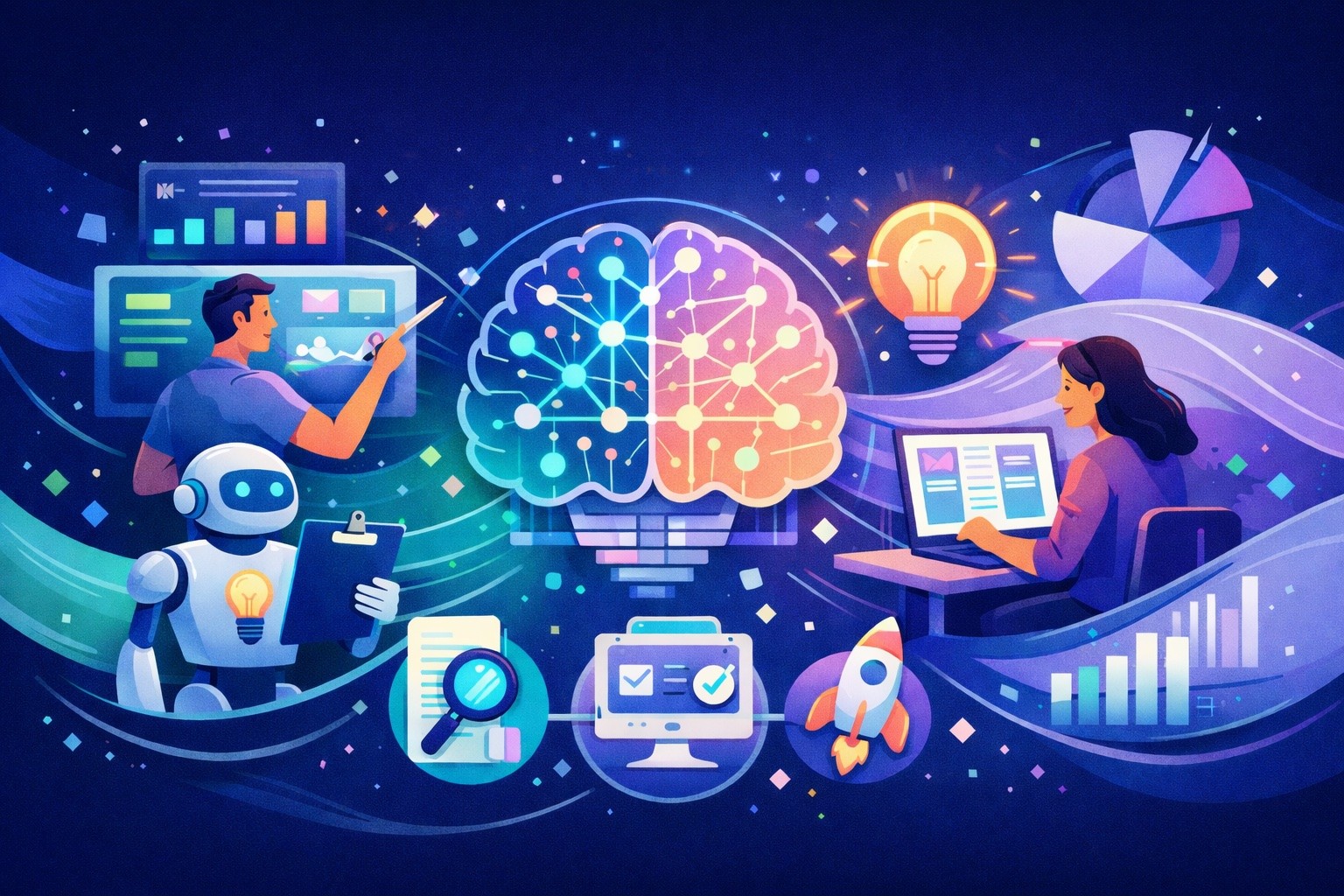
If you’ve spent any time in product recently, you’ve probably felt the ground shifting beneath your feet. Generative AI has arrived with the subtlety of a sledgehammer, and suddenly everyone is either declaring the death of product craft or racing to bolt an LLM onto whatever they’re building.
Personally, I’m far less interested in the hype cycle and far more excited about what AI is already doing for product discovery. Not because it replaces the hard thinking, but because it accelerates the parts of the process that used to slow teams down for all the wrong reasons.
The best framing I’ve seen comes from SVPG: AI doesn’t change what good product teams need to do, but it absolutely changes the speed and leverage with which we can do it.
Faster synthesis, less time stuck in the weeds
One of the biggest immediate wins for product teams has been in UX research synthesis. Traditionally, pulling meaning out of interviews, notes, survey responses, and usability tests is time-consuming, and frankly exhausting. It’s valuable work, but it can also become a bottleneck.
With AI, teams can move from raw qualitative data to themes, emerging patterns, and opportunity areas much faster. That doesn't mean blindly accepting what the model spits out. But it does mean spending less time manually sorting sticky notes and more time applying judgement, asking sharper questions, and validating insights with customers.
In practice, AI is helping me fill in the gaps quicker.
Desk research at the speed of curiosity
The other area where AI is already changing the game is desk research. Competitive analysis, industry benchmarks, market stats, customer sentiment, adjacent product patterns. All the things we used to trawl through manually across a dozen tabs and half-remembered PDFs.
Now, instead of losing half a day, teams can ask targeted questions and quickly assemble a useful baseline. Again, it’s not about trusting it blindly. It’s about accelerating orientation so we can spend our time exploring the real unknowns, not rehashing what’s already out there.
AI has become a kind of research sidekick, the one that doesn’t complain when you ask it to summarise 40 pages of reports before lunch.
In practice, AI is helping me fill in the gaps quicker.
Prototyping in minutes
In design, tools like UX Pilot are starting to shift how quickly teams can explore UI patterns and generate early concepts - sketching an interaction idea, prompting a few variations, and immediately seeing different approaches to layout, hierarchy, or flows.
It’s not replacing design thinking. It’s compressing the iteration cycle.
That’s huge in discovery, where speed matters because learning matters. If a team can prototype three ideas in the time it used to take to build one, they can test earlier, test more broadly, and get to evidence faster.
Product managers are vibing their way into discovery
What’s been especially interesting is how product managers are using AI to 'vibe code' small applications. Lightweight pretotyping tools, clickable demos, basic workflows. Things that would previously have required pulling in engineering capacity or waiting for a sprint.
Now, PMs can create something just real enough to test a hypothesis, validate a workflow, or spark a better conversation with customers.
Edit: They're building to learn. And that’s the key: it’s not about shipping production-grade software. It’s about learning quickly.
Same principles. Stronger teams.
Despite all this acceleration, I keep coming back to the same belief: the principles of product discovery haven’t changed. We still need to understand customers deeply, explore multiple solutions, test assumptions, and iterate toward value.
AI doesn’t remove the need for judgement, strategy, or empowered teams. If anything, it makes the product model even more important. Because when teams can move faster, clarity of purpose and strong decision-making become the real differentiators.
Product discovery in the generative AI era: faster loops, same fundamentals
by Marina Watson
▪ September 2025
If you’ve spent any time in product recently, you’ve probably felt the ground shifting beneath your feet. Generative AI has arrived with the subtlety of a sledgehammer, and suddenly everyone is either declaring the death of product craft or racing to bolt an LLM onto whatever they’re building.
Personally, I’m far less interested in the hype cycle and far more excited about what AI is already doing for product discovery. Not because it replaces the hard thinking, but because it accelerates the parts of the process that used to slow teams down for all the wrong reasons.
The best framing I’ve seen comes from SVPG: AI doesn’t change what good product teams need to do, but it absolutely changes the speed and leverage with which we can do it.
Faster synthesis, less time stuck in the weeds
One of the biggest immediate wins for product teams has been in UX research synthesis. Traditionally, pulling meaning out of interviews, notes, survey responses, and usability tests is time-consuming, and frankly exhausting. It’s valuable work, but it can also become a bottleneck.
With AI, teams can move from raw qualitative data to themes, emerging patterns, and opportunity areas much faster. That doesn't mean blindly accepting what the model spits out. But it does mean spending less time manually sorting sticky notes and more time applying judgement, asking sharper questions, and validating insights with customers.
In practice, AI is helping me fill in the gaps quicker.
Desk research at the speed of curiosity
The other area where AI is already changing the game is desk research. Competitive analysis, industry benchmarks, market stats, customer sentiment, adjacent product patterns. All the things we used to trawl through manually across a dozen tabs and half-remembered PDFs.
Now, instead of losing half a day, teams can ask targeted questions and quickly assemble a useful baseline. Again, it’s not about trusting it blindly. It’s about accelerating orientation so we can spend our time exploring the real unknowns, not rehashing what’s already out there.
AI has become a kind of research sidekick, the one that doesn’t complain when you ask it to summarise 40 pages of reports before lunch.
In practice, AI is helping me fill in the gaps quicker.
Prototyping in minutes
In design, tools like UX Pilot are starting to shift how quickly teams can explore UI patterns and generate early concepts - sketching an interaction idea, prompting a few variations, and immediately seeing different approaches to layout, hierarchy, or flows.
It’s not replacing design thinking. It’s compressing the iteration cycle.
That’s huge in discovery, where speed matters because learning matters. If a team can prototype three ideas in the time it used to take to build one, they can test earlier, test more broadly, and get to evidence faster.
Product managers are vibing their way into discovery
What’s been especially interesting is how product managers are using AI to 'vibe code' small applications. Lightweight pretotyping tools, clickable demos, basic workflows. Things that would previously have required pulling in engineering capacity or waiting for a sprint.
Now, PMs can create something just real enough to test a hypothesis, validate a workflow, or spark a better conversation with customers.
Edit: They're building to learn. And that’s the key: it’s not about shipping production-grade software. It’s about learning quickly.
Same principles. Stronger teams.
Despite all this acceleration, I keep coming back to the same belief: the principles of product discovery haven’t changed. We still need to understand customers deeply, explore multiple solutions, test assumptions, and iterate toward value.
AI doesn’t remove the need for judgement, strategy, or empowered teams. If anything, it makes the product model even more important. Because when teams can move faster, clarity of purpose and strong decision-making become the real differentiators.
Product discovery in the generative AI era: faster loops, same fundamentals
by Marina Watson
▪ September 2025
If you’ve spent any time in product recently, you’ve probably felt the ground shifting beneath your feet. Generative AI has arrived with the subtlety of a sledgehammer, and suddenly everyone is either declaring the death of product craft or racing to bolt an LLM onto whatever they’re building.
Personally, I’m far less interested in the hype cycle and far more excited about what AI is already doing for product discovery. Not because it replaces the hard thinking, but because it accelerates the parts of the process that used to slow teams down for all the wrong reasons.
The best framing I’ve seen comes from SVPG: AI doesn’t change what good product teams need to do, but it absolutely changes the speed and leverage with which we can do it.
Faster synthesis, less time stuck in the weeds
One of the biggest immediate wins for product teams has been in UX research synthesis. Traditionally, pulling meaning out of interviews, notes, survey responses, and usability tests is time-consuming, and frankly exhausting. It’s valuable work, but it can also become a bottleneck.
With AI, teams can move from raw qualitative data to themes, emerging patterns, and opportunity areas much faster. That doesn't mean blindly accepting what the model spits out. But it does mean spending less time manually sorting sticky notes and more time applying judgement, asking sharper questions, and validating insights with customers.
In practice, AI is helping me fill in the gaps quicker.
Desk research at the speed of curiosity
The other area where AI is already changing the game is desk research. Competitive analysis, industry benchmarks, market stats, customer sentiment, adjacent product patterns. All the things we used to trawl through manually across a dozen tabs and half-remembered PDFs.
Now, instead of losing half a day, teams can ask targeted questions and quickly assemble a useful baseline. Again, it’s not about trusting it blindly. It’s about accelerating orientation so we can spend our time exploring the real unknowns, not rehashing what’s already out there.
AI has become a kind of research sidekick, the one that doesn’t complain when you ask it to summarise 40 pages of reports before lunch.
In practice, AI is helping me fill in the gaps quicker.
Prototyping in minutes
In design, tools like UX Pilot are starting to shift how quickly teams can explore UI patterns and generate early concepts - sketching an interaction idea, prompting a few variations, and immediately seeing different approaches to layout, hierarchy, or flows.
It’s not replacing design thinking. It’s compressing the iteration cycle.
That’s huge in discovery, where speed matters because learning matters. If a team can prototype three ideas in the time it used to take to build one, they can test earlier, test more broadly, and get to evidence faster.
Product managers are vibing their way into discovery
What’s been especially interesting is how product managers are using AI to 'vibe code' small applications. Lightweight pretotyping tools, clickable demos, basic workflows. Things that would previously have required pulling in engineering capacity or waiting for a sprint.
Now, PMs can create something just real enough to test a hypothesis, validate a workflow, or spark a better conversation with customers.
Edit: They're building to learn. And that’s the key: it’s not about shipping production-grade software. It’s about learning quickly.
Same principles. Stronger teams.
Despite all this acceleration, I keep coming back to the same belief: the principles of product discovery haven’t changed. We still need to understand customers deeply, explore multiple solutions, test assumptions, and iterate toward value.
AI doesn’t remove the need for judgement, strategy, or empowered teams. If anything, it makes the product model even more important. Because when teams can move faster, clarity of purpose and strong decision-making become the real differentiators.