
Discovery rituals. Empowered teams. Outcome thinking. Product maturity can really get people eye rolling.
In reality, maturity is simply how decisions get made, how teams are supported, and how leaders behave under pressure.
And because designers, product managers and tech leads are all 'product people', design maturity is downstream from product maturity. Strong, strategic design is virtually impossible in an organisation that is operating at a low level of product maturity.
For designers considering a new role, and for hiring managers who genuinely want to build high-performing teams, understanding this distinction matters.
Product maturity shows up in management behaviour
Many organisations describe themselves as 'product-led'. They have roadmaps, quarterly planning cycles, and a few discovery templates floating around. That’s not maturity. That’s tooling.
Product maturity is visible in how product managers are developed and coached. In high-maturity environments:
PMs are coached to define problems clearly before jumping to solutions.
leaders review decision quality, not just delivery progress.
discovery is expected and resourced.
outcomes are discussed as seriously as timelines.
stakeholder pressure is managed rather than absorbed wholesale.
In low-maturity environments:
PMs act primarily as backlog owners.
roadmaps are treated as fixed commitments.
discovery happens if there’s spare time.
success is measured by output and velocity.
escalation flows downward instead of being filtered by leadership.
The difference is not intention. It is reinforcement.
If PMs are not actively coached by their manager on how to operate within a modern product model, the organisation will default to feature delivery mode every time.
Your craft may be strong, but you will lack strategic influence.
Why UX maturity depends on this
UX maturity is often assessed through artefacts: research repositories, design systems, usability testing practices. Those are useful signals. But they are secondary.
True UX maturity exists when:
designers are involved in shaping the problem, not just the interface.
research insights can change priorities.
teams are evaluated on impact, not just shipping.
design has influence because evidence is valued.
That environment requires product managers who:
invite design into discovery early.
protect space for research.
push back on premature solution commitments.
frame work in terms of outcomes.
And PM behaviour, in turn, is shaped by what their manager inspects and rewards. If leadership primarily values predictable delivery, UX will inevitably be constrained. Your craft may be strong, but you will lack strategic influence.
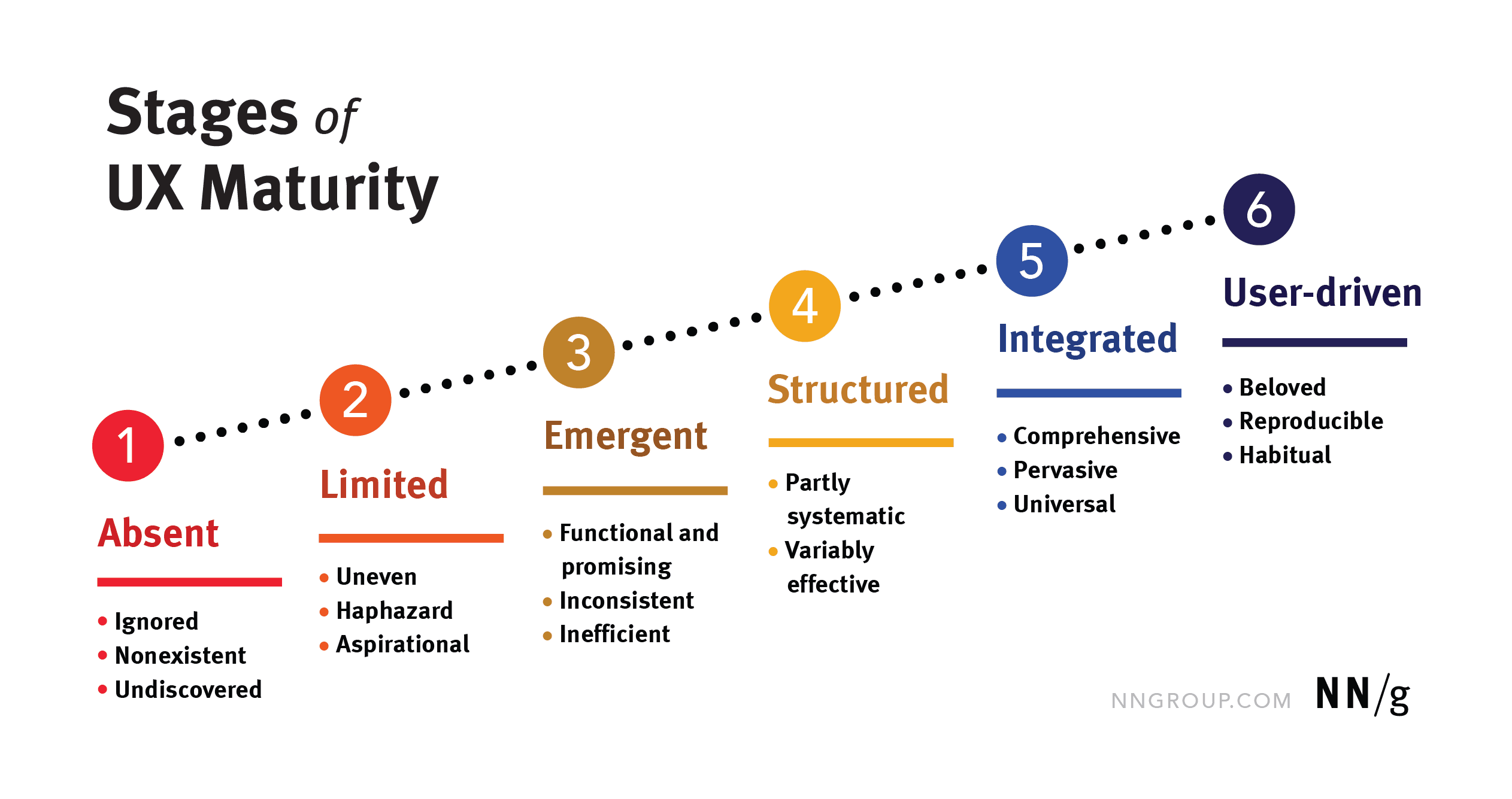
The 6 stages of UX maturity (NN Group, 2024)
How to gauge UX maturity in an interview
Whether you’re a designer assessing a role, or a hiring manager aiming to attract strong talent, these are the signals that matter.
1. Ask how PMs are evaluated
A simple question: “How do you define a high-performing product manager here?”. If the answer centres on:
roadmap execution
stakeholder alignment
on-time delivery
You are likely looking at a lower level of product maturity.
If you hear about:
decision quality
evidence-led prioritisation
outcome ownership
continuous coaching
That’s a stronger signal of maturity.
2. Ask what happens when evidence challenges a plan
In mature environments:
roadmaps are adaptable.
teams can pivot based on learning.
changing direction is seen as responsible decision making.
In less mature ones:
roadmaps are commitments.
discovery validates rather than informs.
deviating from a plan creates friction or blame.
You are not looking for perfection. You are looking for how the organisation handles tension between certainty and learning.
3. Understand the role of product leadership
Ask how Heads of Product lead. Are they:
regularly coaching PMs?
reviewing discovery work and challenging assumptions?
enabling PMs to own product decisions, rather than dictating which features to build?
Or are they:
Primarily reporting upwards?
Managing delivery risk?
Acting as escalation points?
Product maturity requires leaders who build capability, not just communicate upcoming features to senior leadership.
4. Observe how design is described
Listen carefully to language. Is design positioned as:
a strategic partner?
a co-owner of outcomes?
integral to product discovery?
Or as:
responsible for UI and usability?
a service function once scope is defined?
the team that 'makes it look good'?
Language is rarely accidental. It reflects mental models.
5. Ask for a real example
Stories are harder to fake. Ask for a recent example where:
a team changed direction based on research.
a feature was deprioritised due to weak evidence.
a PM received feedback or coaching after a decision.
Specific examples reveal how mature the system actually is.
Maturity is a talent magnet
Strong designers and PMs look for environments where they can have impact, not just output. If you want to attract and retain high-calibre talent:
invest in coaching your PMs.
make outcome ownership explicit.
review decision quality, not just delivery metrics.
model evidence-led behaviour at leadership level.
Maturity is a leadership discipline. Organisations that understand this do not need to oversell themselves in interviews. Their behaviours speak for them.
And designers can thrive in mature environments.
Discovery rituals. Empowered teams. Outcome thinking. Product maturity can really get people eye rolling.
In reality, maturity is simply how decisions get made, how teams are supported, and how leaders behave under pressure.
And because designers, product managers and tech leads are all 'product people', design maturity is downstream from product maturity. Strong, strategic design is virtually impossible in an organisation that is operating at a low level of product maturity.
For designers considering a new role, and for hiring managers who genuinely want to build high-performing teams, understanding this distinction matters.
Product maturity shows up in management behaviour
Many organisations describe themselves as 'product-led'. They have roadmaps, quarterly planning cycles, and a few discovery templates floating around. That’s not maturity. That’s tooling.
Product maturity is visible in how product managers are developed and coached. In high-maturity environments:
PMs are coached to define problems clearly before jumping to solutions.
leaders review decision quality, not just delivery progress.
discovery is expected and resourced.
outcomes are discussed as seriously as timelines.
stakeholder pressure is managed rather than absorbed wholesale.
In low-maturity environments:
PMs act primarily as backlog owners.
roadmaps are treated as fixed commitments.
discovery happens if there’s spare time.
success is measured by output and velocity.
escalation flows downward instead of being filtered by leadership.
The difference is not intention. It is reinforcement.
If PMs are not actively coached by their manager on how to operate within a modern product model, the organisation will default to feature delivery mode every time.
In practice, AI is helping me fill in the gaps quicker.
Why UX maturity depends on this
UX maturity is often assessed through artefacts: research repositories, design systems, usability testing practices. Those are useful signals. But they are secondary.
True UX maturity exists when:
designers are involved in shaping the problem, not just the interface.
research insights can change priorities.
teams are evaluated on impact, not just shipping.
design has influence because evidence is valued.
That environment requires product managers who:
invite design into discovery early.
protect space for research.
push back on premature solution commitments.
frame work in terms of outcomes.
And PM behaviour, in turn, is shaped by what their manager inspects and rewards. If leadership primarily values predictable delivery, UX will inevitably be constrained. Your craft may be strong, but you will lack strategic influence.
The 6 stages of UX maturity (NN Group, 2024)
How to gauge UX maturity in an interview
Whether you’re a designer assessing a role, or a hiring manager aiming to attract strong talent, these are the signals that matter.
1. Ask how PMs are evaluated
A simple question: “How do you define a high-performing product manager here?”. If the answer centres on:
roadmap execution
stakeholder alignment
on-time delivery
You are likely looking at a lower level of product maturity.
If you hear about:
decision quality
evidence-led prioritisation
outcome ownership
continuous coaching
That’s a stronger signal of maturity.
2. Ask what happens when evidence challenges a plan
In mature environments:
roadmaps are adaptable.
teams can pivot based on learning.
changing direction is seen as responsible decision making.
In less mature ones:
roadmaps are commitments.
discovery validates rather than informs.
deviating from a plan creates friction or blame.
You are not looking for perfection. You are looking for how the organisation handles tension between certainty and learning.
3. Understand the role of product leadership
Ask how Heads of Product lead. Are they:
regularly coaching PMs?
reviewing discovery work and challenging assumptions?
enabling PMs to own product decisions, rather than dictating which features to build?
Or are they:
Primarily reporting upwards?
Managing delivery risk?
Acting as escalation points?
Product maturity requires leaders who build capability, not just communicate upcoming features to senior leadership.
4. Observe how design is described
Listen carefully to language. Is design positioned as:
a strategic partner?
a co-owner of outcomes?
integral to product discovery?
Or as:
responsible for UI and usability?
a service function once scope is defined?
the team that 'makes it look good'?
Language is rarely accidental. It reflects mental models.
5. Ask for a real example
Stories are harder to fake. Ask for a recent example where:
a team changed direction based on research.
a feature was deprioritised due to weak evidence.
a PM received feedback or coaching after a decision.
Specific examples reveal how mature the system actually is.
Maturity is a talent magnet
Strong designers and PMs look for environments where they can have impact, not just output. If you want to attract and retain high-calibre talent:
invest in coaching your PMs.
make outcome ownership explicit.
review decision quality, not just delivery metrics.
model evidence-led behaviour at leadership level.
Maturity is a leadership discipline. Organisations that understand this do not need to oversell themselves in interviews. Their behaviours speak for them.
And designers can thrive in mature environments.
Discovery rituals. Empowered teams. Outcome thinking. Product maturity can really get people eye rolling.
In reality, maturity is simply how decisions get made, how teams are supported, and how leaders behave under pressure.
And because designers, product managers and tech leads are all 'product people', design maturity is downstream from product maturity. Strong, strategic design is virtually impossible in an organisation that is operating at a low level of product maturity.
For designers considering a new role, and for hiring managers who genuinely want to build high-performing teams, understanding this distinction matters.
Product maturity shows up in management behaviour
Many organisations describe themselves as 'product-led'. They have roadmaps, quarterly planning cycles, and a few discovery templates floating around. That’s not maturity. That’s tooling.
Product maturity is visible in how product managers are developed and coached. In high-maturity environments:
PMs are coached to define problems clearly before jumping to solutions.
leaders review decision quality, not just delivery progress.
discovery is expected and resourced.
outcomes are discussed as seriously as timelines.
stakeholder pressure is managed rather than absorbed wholesale.
In low-maturity environments:
PMs act primarily as backlog owners.
roadmaps are treated as fixed commitments.
discovery happens if there’s spare time.
success is measured by output and velocity.
escalation flows downward instead of being filtered by leadership.
The difference is not intention. It is reinforcement.
If PMs are not actively coached by their manager on how to operate within a modern product model, the organisation will default to feature delivery mode every time.
Your craft may be strong, but you will lack strategic influence.
Why UX maturity depends on this
UX maturity is often assessed through artefacts: research repositories, design systems, usability testing practices. Those are useful signals. But they are secondary.
True UX maturity exists when:
designers are involved in shaping the problem, not just the interface.
research insights can change priorities.
teams are evaluated on impact, not just shipping.
design has influence because evidence is valued.
That environment requires product managers who:
invite design into discovery early.
protect space for research.
push back on premature solution commitments.
frame work in terms of outcomes.
And PM behaviour, in turn, is shaped by what their manager inspects and rewards. If leadership primarily values predictable delivery, UX will inevitably be constrained. Your craft may be strong, but you will lack strategic influence.
The 6 stages of UX maturity (NN Group, 2024)
How to gauge UX maturity in an interview
Whether you’re a designer assessing a role, or a hiring manager aiming to attract strong talent, these are the signals that matter.
1. Ask how PMs are evaluated
A simple question: “How do you define a high-performing product manager here?”. If the answer centres on:
roadmap execution
stakeholder alignment
on-time delivery
You are likely looking at a lower level of product maturity.
If you hear about:
decision quality
evidence-led prioritisation
outcome ownership
continuous coaching
That’s a stronger signal of maturity.
2. Ask what happens when evidence challenges a plan
In mature environments:
roadmaps are adaptable.
teams can pivot based on learning.
changing direction is seen as responsible decision making.
In less mature ones:
roadmaps are commitments.
discovery validates rather than informs.
deviating from a plan creates friction or blame.
You are not looking for perfection. You are looking for how the organisation handles tension between certainty and learning.
3. Understand the role of product leadership
Ask how Heads of Product lead. Are they:
regularly coaching PMs?
reviewing discovery work and challenging assumptions?
enabling PMs to own product decisions, rather than dictating which features to build?
Or are they:
Primarily reporting upwards?
Managing delivery risk?
Acting as escalation points?
Product maturity requires leaders who build capability, not just communicate upcoming features to senior leadership.
4. Observe how design is described
Listen carefully to language. Is design positioned as:
a strategic partner?
a co-owner of outcomes?
integral to product discovery?
Or as:
responsible for UI and usability?
a service function once scope is defined?
the team that 'makes it look good'?
Language is rarely accidental. It reflects mental models.
5. Ask for a real example
Stories are harder to fake. Ask for a recent example where:
a team changed direction based on research.
a feature was deprioritised due to weak evidence.
a PM received feedback or coaching after a decision.
Specific examples reveal how mature the system actually is.
Maturity is a talent magnet
Strong designers and PMs look for environments where they can have impact, not just output. If you want to attract and retain high-calibre talent:
invest in coaching your PMs.
make outcome ownership explicit.
review decision quality, not just delivery metrics.
model evidence-led behaviour at leadership level.
Maturity is a leadership discipline. Organisations that understand this do not need to oversell themselves in interviews. Their behaviours speak for them.
And designers can thrive in mature environments.